ISCC C2PA Conformance#
| IEP: | 0020 |
|---|---|
| Title: | ISCC C2PA Conformance |
| Author: | Titusz Pan tp@iscc.io |
| Comments: | https://github.com/iscc/iscc-ieps/issues/28 |
| Status: | Draft |
| Type: | Core |
| Standard: | IEP |
| License: | CC-BY-4.0 |
| Created: | 2026-09-24 |
| Updated: | 2026-10-04 |
Note
This document is a DRAFT. It specifies how the ISCC is used within the C2PA framework. This
revision covers the value format of the C2PA soft binding algorithm io.iscc.v0 (entry 3 of the
C2PA Soft Binding Algorithm List), the
input from which its ISCC-UNITs are generated, and their verification against a signed asset. Later
revisions will add further requirements, for example for resolution services.
1. Introduction#
A C2PA soft binding identifies content after its C2PA Manifest has been removed or the content has been re-encoded. The C2PA Technical Specification leaves the value format of each soft binding algorithm to the registry entry of that algorithm.
This document defines the value format of the registry entry io.iscc.v0. The value is an ISCC-SEQ,
a byte string of concatenated ISCC-UNITs. In a C2PA Manifest, the ISCC-UNITs are 256 bits long and
include at least a Data-Code and an Instance-Code. The C2PA Soft Binding Resolution API carries an
ISCC-SEQ in base64.
2. Scope#
This document specifies:
- the ISCC-SEQ byte format and its decoding;
- the value format of
c2pa.soft-bindingassertions withalgequal toio.iscc.v0; - the input from which the ISCC-UNITs of such an assertion are generated;
- the verification of such an assertion against an asset, including whether the asset is source-preserving;
- the value format of
io.iscc.v0queries to the C2PA Soft Binding Resolution API.
The requirements apply to claim generators that write ISCC soft bindings and to validators and resolvers that read them.
3. Terminology#
The terms ISCC-UNIT, ISCC-HEADER, ISCC-BODY, ISCC-CODE, MainType, SubType, Version and Length apply as defined in ISO 24138:2024 and IEP-0001. The terms soft binding, claim generator, validator, resolver, C2PA Manifest, active manifest, C2PA Manifest Store, claim signature, hashed URI, hard binding, data hash assertion and exclusion range apply as defined in the C2PA Technical Specification.
ISCC-SEQ : byte string formed by concatenating one or more ISCC-UNITs, each encoded as its ISCC-HEADER followed by its ISCC-BODY, without separators
ISCC soft binding : ISCC-SEQ that is a blocks[].value of a c2pa.soft-binding assertion with
alg equal to io.iscc.v0
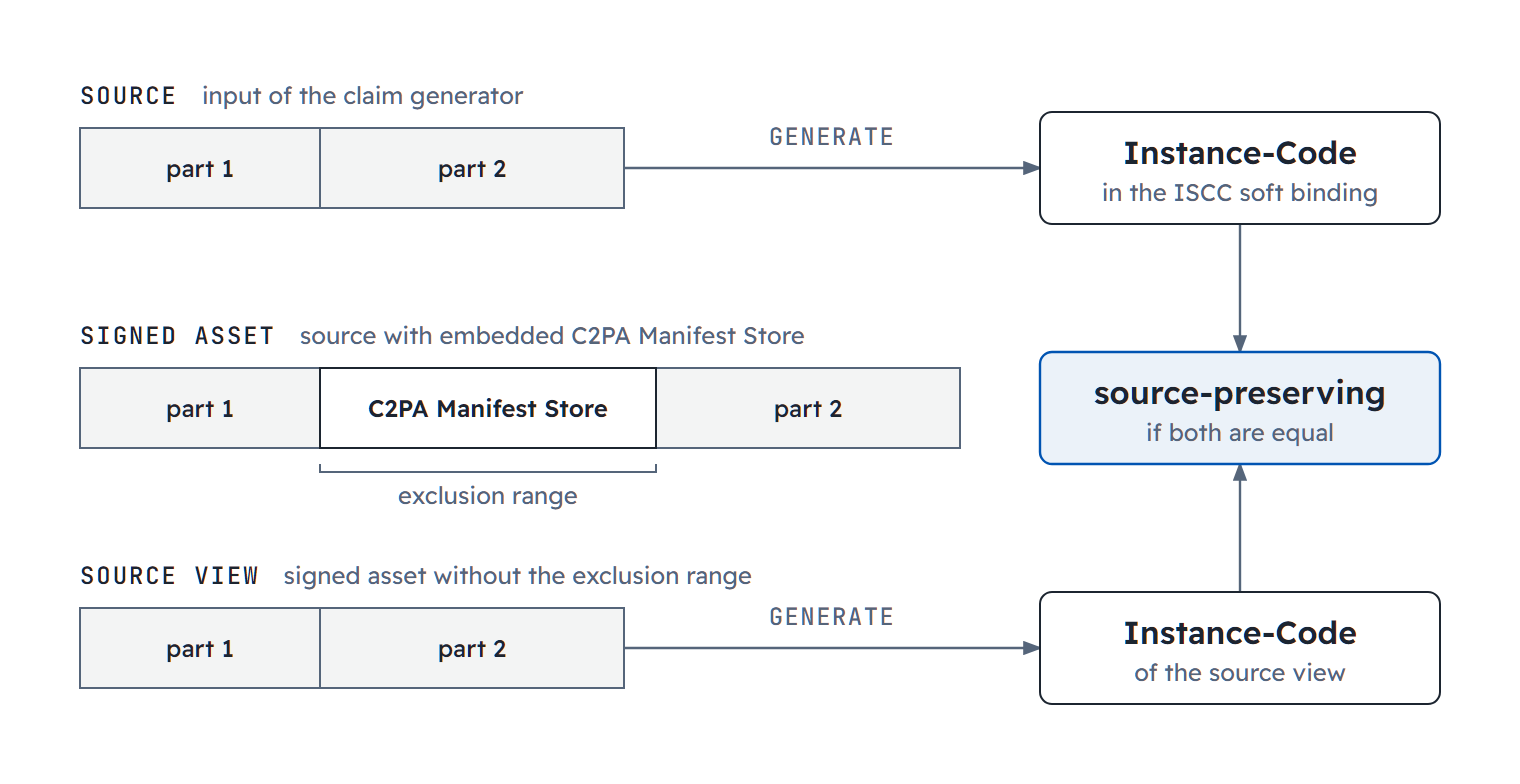
source : complete byte stream into which a claim generator embeds a C2PA Manifest Store, including any C2PA Manifest Store that the byte stream already contains
source view : byte stream formed by the bytes of a signed asset outside the exclusion ranges of the data hash assertion of its active manifest
source-preserving : characterized by a data hash assertion whose exclusion ranges cover only the C2PA Manifest Store and by a source view that equals its source, byte for byte
4. Soft Binding Value#
4.1 ISCC-SEQ Format#
An ISCC-SEQ shall satisfy all of the following:
- It shall consist of one or more ISCC-UNITs of MainType META (0), SEMANTIC (1), CONTENT (2), DATA (3) or INSTANCE (4).
- Each ISCC-UNIT shall be encoded as its ISCC-HEADER immediately followed by its ISCC-BODY.
- Each ISCC-HEADER shall use the variable-length nibble encoding of ISO 24138:2024, padded with one zero nibble where the number of nibbles is odd.
- Each Length field shall have a value from 0 to 7. The ISCC-BODY then has 32 × (Length + 1) bits.
- The ISCC-UNITs shall be concatenated without separators, length prefixes or trailing bytes.
The order of ISCC-UNITs is not significant. An ISCC-SEQ may contain several ISCC-UNITs with the same MainType, SubType and Version.
For these MainTypes, the length of the ISCC-BODY depends on the Length field only. A decoder can thus find the end of an ISCC-UNIT whose SubType or Version it does not know.
NOTE
An ISCC-SEQ with one ISCC-UNIT is the byte encoding of that ISCC-UNIT as defined in ISO 24138:2024.
For display, an ISCC-SEQ can be written as ISCC: followed by the base32 encoding of its bytes, in
the same way as an ISCC-UNIT.
4.2 Decoding#
A decoder shall process an ISCC-SEQ from offset 0 as follows:
- Decode the ISCC-HEADER at the current offset. Reject the ISCC-SEQ if the bytes end before the ISCC-HEADER is complete. Reject it also if the ISCC-HEADER bytes are not the encoding of the decoded fields as specified in ISCC-SEQ Format, item C.
- Reject the ISCC-SEQ if ISCC-SEQ Format, item A does not permit the MainType, or if the Length field is greater than 7.
- Reject the ISCC-SEQ if fewer bytes remain than the ISCC-BODY requires.
- Output the ISCC-UNIT and move the offset to the end of its ISCC-BODY. If bytes remain, continue with step A.
A decoder shall not reject an ISCC-UNIT solely because its SubType or Version is unknown to it. A decoder shall not alter, reorder or drop ISCC-UNITs.
4.3 Assertion#
A c2pa.soft-binding assertion that contains ISCC soft bindings shall satisfy Table 1.
Table 1 – c2pa.soft-binding fields for io.iscc.v0
| Field | Requirement |
|---|---|
alg |
shall be io.iscc.v0 |
blocks[].value |
shall be a CBOR byte string (major type 2) whose content is an ISCC-SEQ |
alg-params |
shall be absent |
Each ISCC-UNIT of an ISCC soft binding shall have Version 0 and a 256-bit ISCC-BODY (Length field equal to 7). A validator or resolver shall ignore, for matching, each ISCC-UNIT that it does not support or whose ISCC-BODY is shorter than 256 bits.
NOTE 1
Soft binding resolution is a lookup in a catalog of unlimited size. In such a catalog, shorter ISCC-UNITs of different content collide at random. IEP-0013 uses 256-bit ISCC-UNITs for the same reason.
A claim generator shall include the Data-Code and the Instance-Code of the source in each ISCC soft binding. It should also include one or more Content-Codes if the source contains text, image, audio or video content. It may include a Semantic-Code and a Meta-Code.
NOTE 2
The Data-Code and the Instance-Code can be generated for every file format. They identify the source at byte level. A re-encoded copy of the source has a different Data-Code and Instance-Code, but a similar Content-Code. This difference alone does not show that the ISCC soft binding does not match the copy.
NOTE 3
ISO 24138:2024 does not define a Semantic-Code algorithm. The Version 0 Semantic-Codes for text and image are those of the reference implementations iscc-sct and iscc-sci. They are generated with neural network models. Semantic-Codes that different implementations generate from the same content can thus differ in some bit positions.
Whole-asset value with Meta-, Content-, Data- and Instance-Code (256 bits each)
blocks[].value is the 136-byte ISCC-SEQ of Test Vector 1. Its CBOR encoding starts with 58 88
(byte string, length 136). With the reference implementation:
import base64
import iscc_core as ic

units = [
    "ISCC:AADVPDD4R6733NMPFH3D57VTQ4KVH6VHL74XIWGUT37V5ZG56NV3NSI",  # Meta-Code
    "ISCC:EAD2RASIYU5IKLENP2OFI4CHZGRWYQCSW2WKX3Y6FJGOCXSYNYGLGBI",  # Content-Code Text
    "ISCC:GADQLNA7GRZESMRF2J7NZPNWGI3II2ST5YUN5SS6GVQ2ZQGJXPPYDNI",  # Data-Code
    "ISCC:IAD2KIVPJIWJZP3KQCESJL6SVT5APEZUPOJWM6HVTAXCF7OT3VFA4NY",  # Instance-Code
]

# Claim generator: content of blocks[].value (CBOR byte string)
value = ic.encode_seq(units)  # 136 bytes

# Soft Binding Resolution API: value parameter or body member
query = base64.b64encode(value).decode("ascii")  # RFC 4648 section 4, padded

# Validator or resolver: back to ISCC-UNITs
assert ic.decode_seq(value) == units
assert ic.decode_seq(base64.b64decode(query)) == units

# Display
text = "ISCC:" + ic.encode_base32(value)
5. Soft Binding Input#
A claim generator shall generate each ISCC-UNIT of an ISCC soft binding, except a Meta-Code, from the source. It shall process the source as a whole. It shall not remove, skip or normalize any part of the source before generation. This includes a C2PA Manifest Store that the source already contains.
A Meta-Code is generated from metadata. This document does not specify that metadata or its verification.
NOTE
If content is edited before it is signed, the source is the edited rendition that the claim generator signs. It is not the asset that was opened for editing.
6. Verification#
6.1 Source Preservation#
Figure 1 shows the relation between the source, the signed asset and the source view.
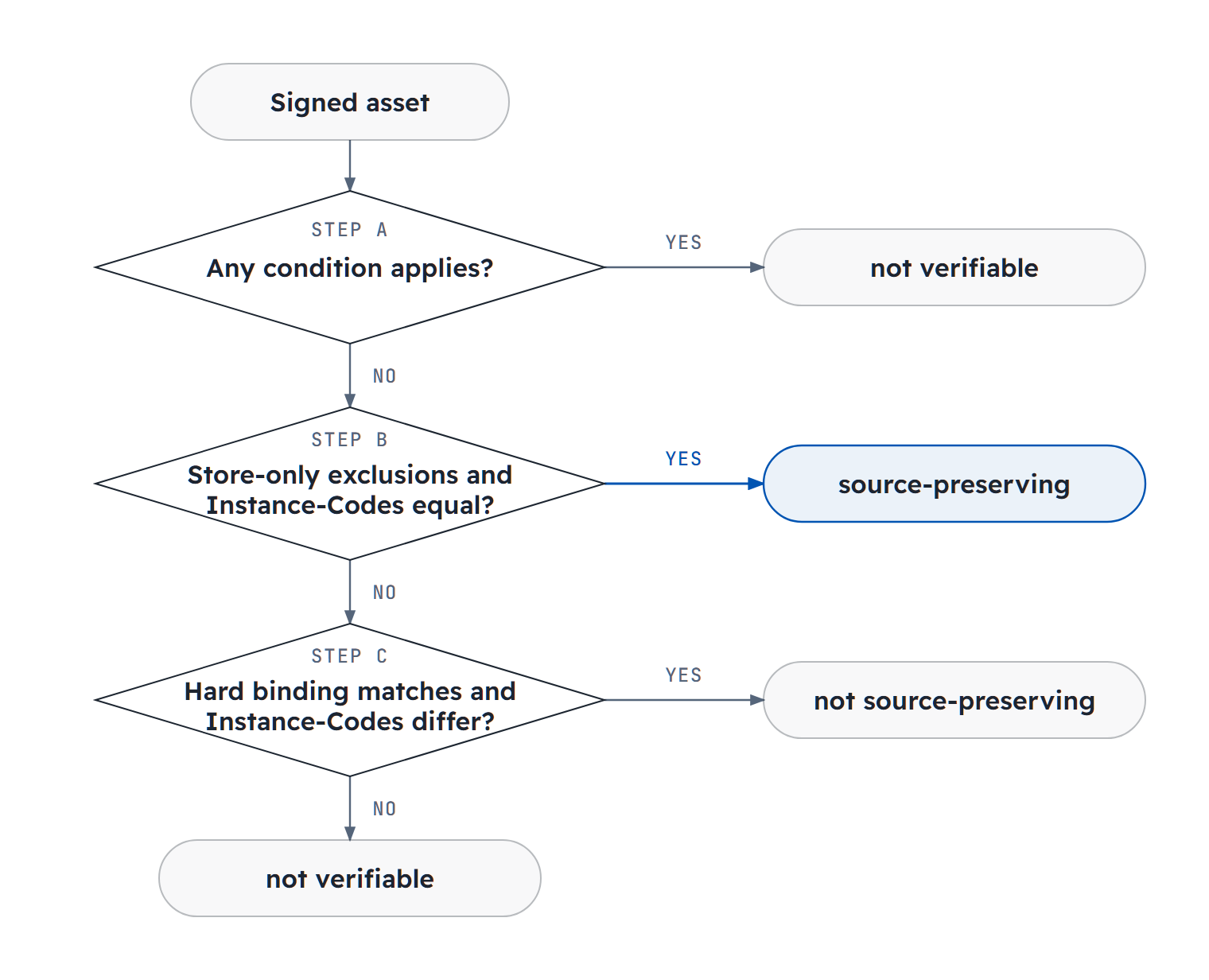
A validator that reports whether a signed asset is source-preserving shall apply the following steps to the active manifest in the given order. It shall report the first result that applies.
- Report not verifiable if one or more of these conditions apply:
- the claim signature does not validate;
- an assertion does not match its hashed URI in the claim;
- the hard binding is not a data hash assertion (
c2pa.hash.data); - no ISCC soft binding has an Instance-Code.
- Report source-preserving if the exclusion ranges of the data hash assertion cover only the C2PA Manifest Store and the Instance-Code generated from the source view equals the Instance-Code of an ISCC soft binding.
- Report not source-preserving if the hard binding matches the asset and no ISCC soft binding has an Instance-Code equal to the one generated from the source view.
- Report not verifiable.
Step B is conclusive. The Instance-Code is a cryptographic hash of the source, and the condition on the exclusion ranges makes sure that the source view lacks nothing but the C2PA Manifest Store. Step A makes sure that the claim signature protects the Instance-Code of the ISCC soft binding and the exclusion ranges of the data hash assertion.
Figure 2 shows the steps as a flowchart.
NOTE
Not source-preserving does not show a change after signing, because the hard binding matches. It shows that the embedding changed bytes outside the C2PA Manifest Store, that the exclusion ranges cover bytes of the source (for example asset metadata), or that the source already contained a C2PA Manifest Store, which the embedding replaces. BMFF-based and ZIP-based assets are always not verifiable, because their hard bindings are not data hash assertions.
6.2 Soft Binding Verification#
A validator that verifies an ISCC soft binding against an asset shall generate an ISCC-UNIT for each ISCC-UNIT of the ISCC soft binding that it supports. The generated ISCC-UNIT shall have the same MainType, SubType, Version and Length. The validator shall generate it from the input given in the first row of Table 2 that applies to the asset.
Table 2 – Input for the generation of ISCC-UNITs
| Asset | Data-Code, Instance-Code | Content-Code, Semantic-Code |
|---|---|---|
| source-preserving signed asset | source view | source view |
| other signed asset whose hard binding is a data hash assertion | source view | asset |
| any other asset | asset | asset |
The validator shall compare each Instance-Code of the ISCC soft binding with the generated Instance-Code for equality. It shall compare each other ISCC-UNIT with its generated counterpart by the number of bit positions in which their ISCC-BODYs differ. This document does not specify a similarity threshold.
If the result for a signed asset is not source-preserving, the Data-Code and the Instance-Code of the ISCC soft binding identify the source, not the signed asset. A validator should then show them as codes of the source. It should not report their difference as a failed match.
NOTE
The Data-Code and the Instance-Code are generated from all bytes of their input. The source view keeps the C2PA Manifest Store out of that input. The Content-Code and the Semantic-Code are generated from decoded content. A source view that differs from the source is not necessarily decodable, but the asset is. A source view that equals the source gives the ISCC-UNITs of the source exactly, also for formats in which the decoded content includes the C2PA Manifest Store.
7. Soft Binding Resolution API#
An io.iscc.v0 query to the C2PA Soft Binding Resolution API shall satisfy all of the following:
- The
algparameter or member shall beio.iscc.v0. - The
valueparameter ofGET /matches/byBindingand thevaluemember of thePOST /matches/byBindingrequest body shall be the base64 encoding of an ISCC-SEQ as specified in RFC 4648 section 4, with padding characters. - In a
GETrequest the base64 string shall be percent-encoded.
The ISCC-SEQ of a query should include a Data-Code and an Instance-Code.
8. Security Considerations#
In a C2PA Manifest, the claim signature protects the ISCC soft binding. An ISCC-SEQ has no integrity protection of its own. The Decoding procedure rejects malformed byte strings and does not try to repair them. It does not detect changes that keep the byte string well-formed.
Only the Instance-Code is a cryptographic hash. Equal 256-bit Instance-Codes show that two inputs are identical. A match of any other ISCC-UNIT shows that two inputs are similar. It does not show that they are identical.
The ISCC-UNITs of an ISCC soft binding are statements of the signer. The claim signature protects them through the hashed URI of the soft binding assertion. The hard binding does not protect them. The result source-preserving shows that the source view equals the source that the Instance-Code identifies. It does not show that the signer generated the other ISCC-UNITs correctly. Soft Binding Verification shows that.
The signer chooses the exclusion ranges of the data hash assertion, and neither the hard binding nor
the Instance-Code covers the bytes in them. A C2PA validator conforming to version 2.3 or later of
the C2PA Technical Specification rejects an exclusion range that holds data other than the C2PA
Manifest Store, but it accepts further exclusion ranges and reports them only with the informational
code assertion.dataHash.additionalExclusionsPresent. With such a validator, a matching hard
binding without that code shows that the exclusion ranges cover only the C2PA Manifest Store.
9. Reference Implementation#
iscc-core, the reference implementation published with ISO 24138:2024, already decomposes the base32
form of concatenated ISCC-UNIT bytes into its ISCC-UNITs (iscc_decompose). Version 1.4.0 adds
encode_seq (ISCC-UNIT strings to ISCC-SEQ bytes) and decode_seq (ISCC-SEQ bytes to ISCC-UNIT
strings) as strict byte-level helpers, together with conformance test vectors. Entry 3 of the C2PA
Soft Binding Algorithm List shall reference this document as its informationalUrl.
The ISCC C2PA Demo is an open-source desktop application and command line tool built on c2pa-rs, the C2PA SDK of the Content Authenticity Initiative. It signs assets with ISCC soft bindings as specified in this document and performs the Source Preservation check and Soft Binding Verification.
10. Test Vectors#
Conforming encoders shall produce, and conforming decoders shall accept, the following byte strings.
Vector 1 – the four ISCC-UNITs of the example in Assertion, in the given order:
0007578c7c8fbfbdb58f29f63efeb3871553faa75ff97458d49eff5ee4ddf36bb6c92007a88248c53a852c8d7e9c547047c9a36c4052b6acabef1e2a4ce15e586e0cb305300705b41f3472493225d27edcbdb63236846a53ee28deca5e3561acc0c9bbdf81b54007a522af4a2c9cbf6a808924afd2acfa0793347b936678f5982e22fdd3dd4a0e37
AAdXjHyPv721jyn2Pv6zhxVT+qdf+XRY1J7/XuTd82u2ySAHqIJIxTqFLI1+nFRwR8mjbEBStqyr7x4qTOFeWG4MswUwBwW0HzRySTIl0n7cvbYyNoRqU+4o3speNWGswMm734G1QAelIq9KLJy/aoCJJK/SrPoHkzR7k2Z49ZguIv3T3UoONw==
Vector 2 – mixed lengths with two CONTENT SubTypes, ISCC:EEAYYNMFG5XOELK2 (Image, 64 bits),
ISCC:EIBZ6B7T76PAAYP7H334X77754376 (Audio, 128 bits) and
ISCC:GADQLNA7GRZESMRF2J7NZPNWGI3II2ST5YUN5SS6GVQ2ZQGJXPPYDNI (Data, 256 bits):
21018c3585376ee22d5a22039f07f3ff9e0061ff3ef7cbffffef37ff300705b41f3472493225d27edcbdb63236846a53ee28deca5e3561acc0c9bbdf81b5
Conforming decoders shall reject the byte strings in Table 3.
Table 3 – Byte strings that decoders shall reject
| Bytes (hex) | Reason |
|---|---|
| (empty) | no ISCC-UNIT |
28000100000000 |
nonzero header padding nibble (valid form 28000000000000) |
200800 followed by 36 zero bytes |
Length field 8 |
3000000000 |
ISCC-BODY truncated (32-bit Data-Code with 3 body bytes) |
30000000000000 |
trailing byte after a complete ISCC-UNIT |
5005578c7c8fbfbdb58fa88248c53a852c8d05b41f3472493225a522af4a2c9cbf6a |
ISCC-CODE (MainType 5) |
60100000000000000000 |
ISCC-ID (MainType 6) |
Conforming decoders shall accept 270000000000 (CONTENT, SubType 7, Version 0, 32 bits) and return
ISCC:E4AAAAAAAA, although SubType 7 is not defined by ISO 24138:2024.
NOTE
Vector 2 and the 32-bit acceptance test exercise the ISCC-SEQ codec only. They are not conforming ISCC soft bindings, which require 256-bit ISCC-UNITs that include a Data-Code and an Instance-Code.
11. References#
11.1 Normative#
- ISO 24138:2024 - International Standard Content Code
- IEP-0001 - ISCC Structure and Format
- C2PA Technical Specification 2.4, Soft Binding assertion
- C2PA Technical Specification 2.4, Data Hash
- C2PA Soft Binding Resolution API 2.4
- RFC 4648 - The Base16, Base32, and Base64 Data Encodings
- RFC 8949 - Concise Binary Object Representation (CBOR)
11.2 Informative#
- IEP-0013 - ISCC Discovery Protocol
- C2PA Soft Binding Algorithm List
- iscc-core - Reference implementation
- iscc-sct - Semantic-Code Text
- iscc-sci - Semantic-Code Image
- ISCC C2PA Demo - Signing and verification